
What is the difference between PDM and PLM?
PDM (product data management) controls the engineering data that defines a product: CAD files, drawings, specifications, bills of materials, revisions, and the change requests and approvals behind them. Its users are mainly engineers, quality staff and the suppliers who build from released drawings. PLM (product lifecycle management) is a broader strategy and software category that extends that control across the whole life of a product, from requirements and sourcing through manufacturing planning, service and end of life, and connects engineering data to ERP and manufacturing systems. PLM involves product management, purchasing, production and service as well as engineering. The two are layers rather than rivals. PDM is the foundation PLM depends on, because a PLM system can only connect the rest of the business to revisions and BOMs that are already under control. Most hardware teams need PDM first. PLM tends to pay off later, when several departments must work from the same product structure across many product lines.
What PDM covers
A PDM system tells you the current, approved definition of a product and how it got there. Its core jobs:
- Version and revision control for CAD files and documents.
- Controlled editing, so changes do not overwrite each other.
- Parts, assemblies and bills of materials linked to their documents.
- Change requests and change orders that record why something changed and who approved it.
- Release workflows and an audit trail.
- Access control for internal teams and for suppliers.
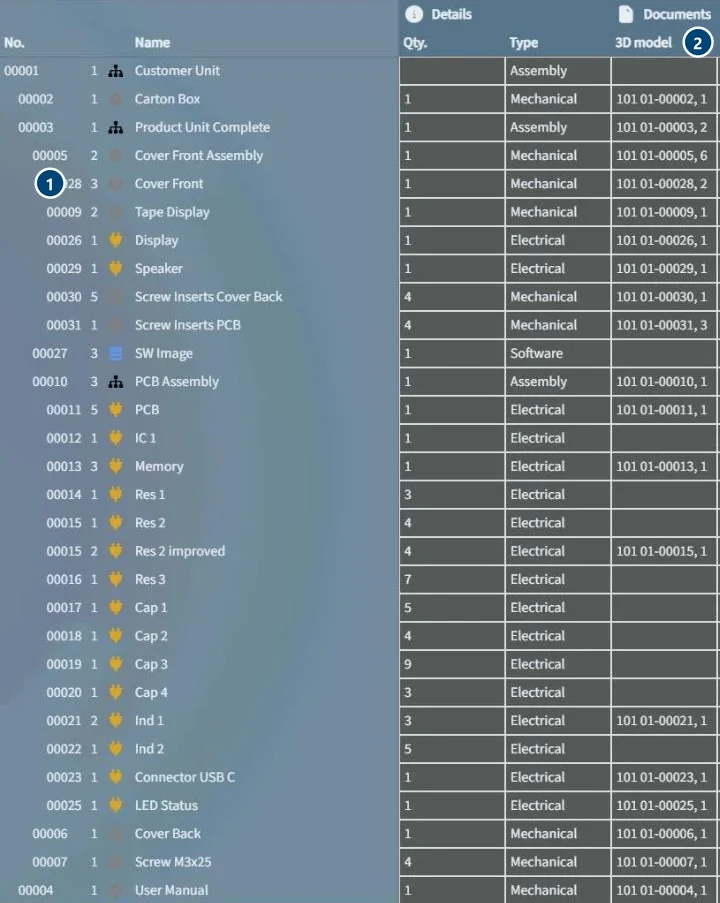 A bill of materials in neo. 1: assemblies and parts in levels. 2: each row linked to its 3D model, with document number and revision.
More detail: what is PDM.
What PLM covers
PLM takes the product definition from PDM and connects it to the rest of the business. Depending on the vendor and the modules you buy, a PLM suite can include:
- Requirements management and traceability from requirement to design.
- Program and portfolio management across many products.
- Sourcing, supplier collaboration and cost management.
- Manufacturing process planning and links to MES and ERP.
- Quality management, including nonconformances and corrective actions.
- Service, field data and end-of-life processes.
PLM works as an architecture of modules. Most companies configure their PLM implementation to their own processes and widen the scope over years.
PDM and PLM side by side
| PDM | PLM | |
|---|---|---|
| Scope | Engineering data: CAD, documents, BOMs, revisions, changes | The full product lifecycle, from concept to retirement |
| Primary users | Engineers, quality, document control, suppliers who need drawings | Engineering plus product management, sourcing, manufacturing, service and leadership |
| Data | Files, metadata, parts and BOMs, change records | All PDM data plus requirements, processes, costs, projects and links to ERP and MES |
| Typical cost and complexity | Moderate; one system with a clear purpose | High; several modules, integrations and usually an implementation partner |
| Time to value | Weeks | Months to years, depending on scope |
| Main risk | Too little: files drift back to shared drives | Too much: a large project that people work around |
How PDM and PLM relate
PDM is the layer PLM depends on. If your revisions, BOMs and approvals are out of control, a PLM system has nothing trustworthy to connect to the rest of the business, so most PLM strategies start by getting PDM right.
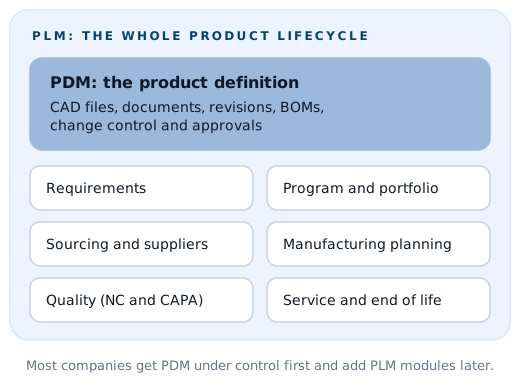
The two also overlap. Many PDM systems now include change management, release workflows and supplier access, which used to be sold as PLM. Many PLM vendors sell PDM as the entry module. Decide which processes you need under control now and which can wait; the label on the software matters less.
Which do you need? A decision guide
The answer depends on team size, the number of products and how many functions outside engineering need to work in the same system.
Early-stage hardware startup (one product, a few engineers). You need PDM. The goal is a single source of truth for CAD and documents, revision control and a basic release process before the first production run.
Growing product company (several products, contract manufacturing, a quality system). You need PDM with change management, approvals and supplier sharing. Most of your risk sits here: outdated drawings at suppliers, approvals in email, audit preparation by hand.
Regulated hardware (medical devices, products under ISO 13485, ISO 9001 or the Cyber Resilience Act). You need PDM with an audit trail, electronic signatures and document control that produces evidence as you work. Compliance requires controlled records; it does not require a PLM suite.
Large or multi-division manufacturer (many product lines, in-house production, global sourcing). PLM starts to pay off when requirements, manufacturing planning, sourcing and service all need to work from the same product structure, and you have the people to run it.
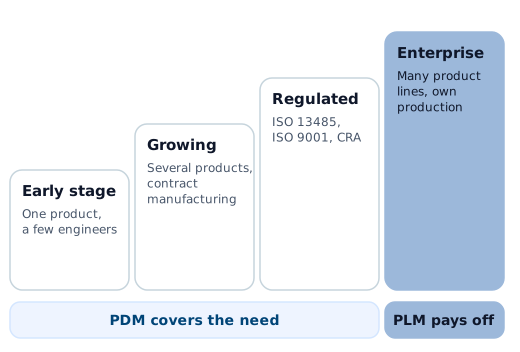
A test: if most of your pain is "which revision is right, who approved it, and does the supplier have it", that is a PDM problem. If it is "how do we coordinate requirements, costs and manufacturing across dozens of programmes", that is a PLM problem.
The common mistake: buying PLM too early
Smaller hardware companies often buy PLM because it sounds like the complete answer. They end up with a long implementation, unused modules and engineers who go back to shared drives because the system is heavier than the work.
Signs you are buying too early:
- Nobody can name which PLM modules will be in daily use in the first six months.
- The implementation plan is longer than your next product cycle.
- You need a consultant to change a workflow.
- The main problem you are trying to solve is revision control or approvals.
If you start with PDM, you get the foundation and the records auditors ask for, and you can add broader lifecycle tools later when the need is concrete. Make sure the system you choose lets you export your data, so the next step does not turn into a migration project.
What neo covers, and what it leaves to PLM
neo is a cloud PDM for hardware teams. Beyond the PDM core, it covers the lifecycle work hardware teams run into first: change requests with impact analysis, release dossiers with electronic signatures, and supplier portals. It does not include requirements management, manufacturing execution or ERP modules. It can connect to ERP and quality systems, and you can export all data at any time, so a later move to PLM starts from clean data. If you are deciding between PDM and PLM, see how neo works or talk to us about where your team is today.