
neo PDM is cloud PDM software for hardware teams. It keeps CAD files, documents, revisions, approvals and product data connected in one controlled workspace, hosted in the EU. Change requests, approvals and release dossiers are built in, neo logs every action, and suppliers see only what they need. You can start with a free three-month pilot on your own data.
Who neo is for
We built neo for engineering teams that ship physical products and revise them after the first release. Most of them work in regulated or demanding markets: medical devices, IoT, sports technology and optics.
Inside those teams, three groups care most:
- Engineering managers and engineers, who want one place to find the released revision and a clear path for changing it.
- Quality and regulatory leads, who need approvals, signatures and audit trails that hold up in an inspection.
- Operations and supplier leads, who share drawings and specifications with contract manufacturers and want to stop emailing files or handing out broad access.
If your team is small and growing, see PDM software for small engineering teams. If you are moving off an on-premise system, see the SOLIDWORKS PDM alternative page.
One source of truth
A PDM system should tell you which revision is current, and who released it, without you asking a colleague.
- CAD files and documents in one workspace. Drawings, models, specifications, test reports and quality records sit together, with versions and formal revisions.
- Projects that hold the context. A project bundles the documents, parts and approvals that belong together, and its permissions pass down to everything in it.
- Your nomenclature. Part numbers and document IDs follow the scheme you configure, so neo matches how your team already identifies things.
- neoDrive for desktop files. neoDrive syncs local files into neo, including files from mechanical and electrical CAD systems, and works across multiple platforms. Engineers keep working in their own tools while neo puts the files under control.
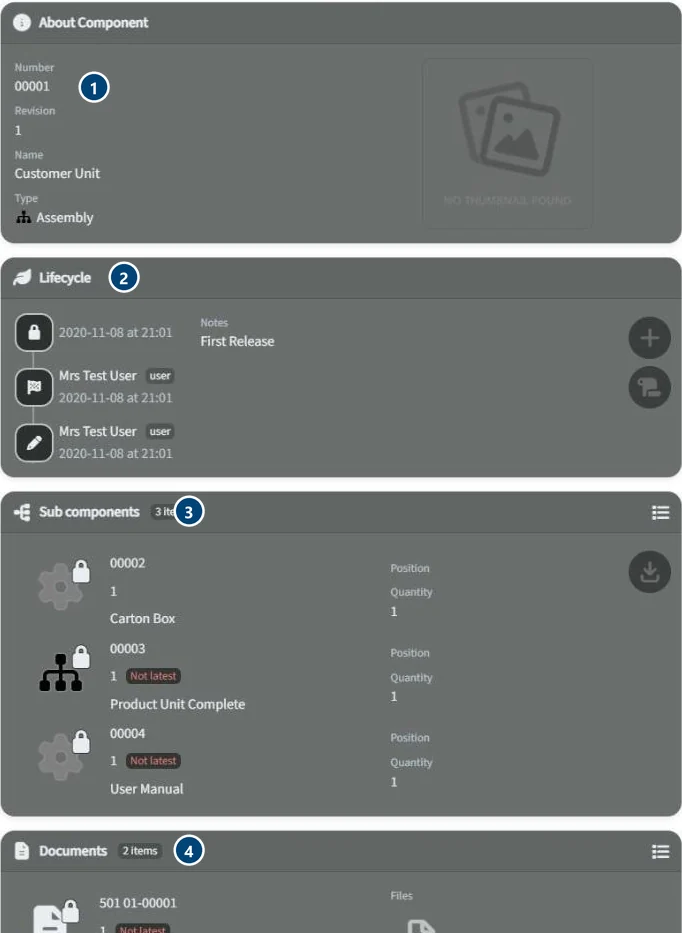 Everything about an item in one place. 1: number, revision and type. 2: the lifecycle. 3: sub-components. 4: linked documents, flagged when a newer revision exists.
Controlled change
Most of the risk in hardware development sits in changes after the first release. In neo, change requests, approvals and release dossiers are first-class objects instead of email threads.
- Propose a change from any item and attach the impacted documents.
- Route it through the approval chain you have configured, with parallel approvals across engineering, quality and suppliers.
- See the impact. Impact analysis shows what blocks the change before anyone approves it.
- Sign and release. neo notifies reviewers in the app and by email, and they sign with validated electronic signatures.
- Get the dossier. On approval, neo assembles the release dossier automatically, with metadata, signatures and artifacts, ready to export to PDF and share with auditors.
neo's electronic signatures and audit trails are designed to meet 21 CFR Part 11 requirements, and the workflow supports FDA, ISO 13485 and ISO 9001 style document control. Read more about engineering change management.
Built for engineering teams
If the controlled path is also the easy one, your files stay out of shared drives.
- Dashboards and notifications. Role-based alerts show what is waiting for you, and metadata links every artifact to the change it came from.
- Supplier and customer portals. External partners get granular permissions and see only what they need.
- Configurable templates. Templates check that a document set is complete before it moves on.
- Your data stays yours. You can export all data at any time.
For a full list, see the feature overview.
How teams start
Most teams run the pilot on a real project instead of a sandbox. The pilot is free for three months.
During onboarding, the neo success team helps you define nomenclature and part numbering, then migrates your existing data: spreadsheets, legacy PDM or PLM exports, CAD files and quality records. Your historical data is typically inside neo within days, and most teams are productive within a few weeks.
The people who built neo handle support, with no ticket queue. You get a reply within one business day, usually the same day, and every customer has a success manager with quarterly reviews. See how it works for onboarding details.
Security and hosting
- Hosted in the EU.
- Field-level encryption.
- Granular role-based permissions: view, edit, approve and release, with Read/Write, Read-only and administrator roles per workspace or project.
- Complete audit logs of who did what, and when.
neo can connect to ERP and quality systems; talk to us about your setup. Read more about cloud PDM.
Pricing
neo is priced per user per month:
| Seat | Price per user per month |
|---|---|
| Read/Write | 500 SEK |
| Read | 200 SEK |
| neoDrive | 150 SEK |
Volume pricing applies above 10 users, and you can run the first three months as a free pilot. Read seats cannot create or check in files. See pricing for details.
Teams using neo
- Sensative builds IoT sensors and gateways. Its catalog of more than 50,000 parts lives in neo, and audit preparation has gone from weeks to days.
- Triomed develops a peritoneal dialysis medical device. It runs a closed-loop quality process in neo across four sites and stays audit-ready.
- Spiideo makes AI sports production systems and configures customer-specific product variants in neo.
- Spec-Imaging builds optical measurement instruments, including the IC-VIS colorimeter, and keeps its full product structure in neo.
CoreDEQ and Tendo also use neo. More on the customers page.
See it with your own data
You judge PDM software best by watching it handle your own files and your own approval flow. Take the product tour, or talk to us about a pilot.